Choosing Mugs and Bottles for Events
Mugs and bottles suit events in different ways: a mug suits an indoor table and a desk setting, while a bottle suits an outdoor day and a bag setting.
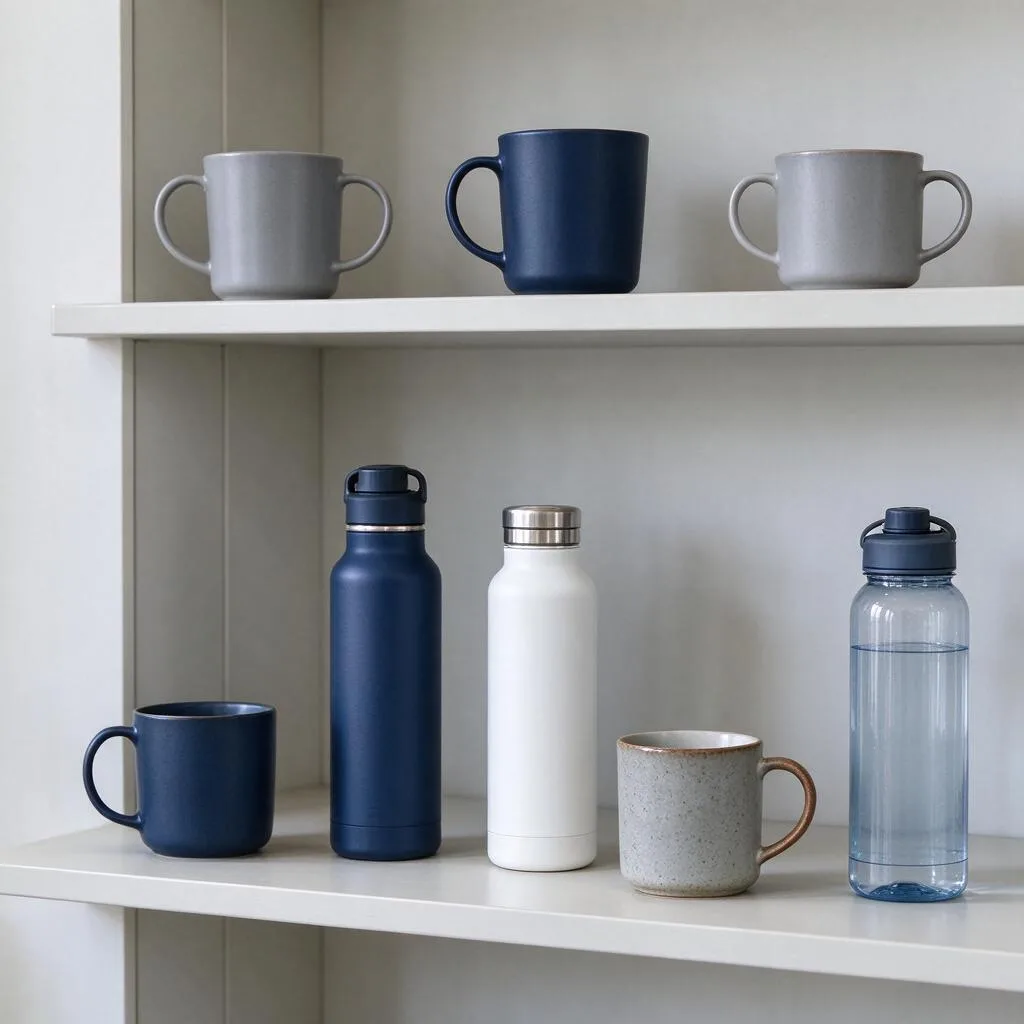
Start from the event setting
Event setting is the first choice for mugs and bottles, because an indoor event and an outdoor event ask for different items. An indoor conference suits mugs, planned for a table during talks and for a desk afterwards, while an outdoor festival suits bottles, planned for hand and bag carry through a long day outside. Name the setting in the brief, so the item choice follows the event rather than a habit.
A mixed event with indoor and outdoor parts can carry both items, with mugs for the indoor sessions and bottles for the outdoor parts. State both items in one brief, with a quantity beside each item, so the whole event order is visible at once. A brief that covers both settings avoids a second order placed after the first has already gone out.
Mugs for indoor events
Mugs suit indoor events: plan the mug for the event itself and for a desk place afterwards. A plain mug in a tidy colour suits a conference table, where the mug sits beside a notebook and a pen, while a mug in a campaign colour suits a launch table, where the mug carries the campaign look. State the mug style and colour together in the brief, so the table look and the mug look are planned as one.
A mug also suits a gift set, because a mug pairs well with a pen and a notebook for a desk, or with a bag for a visitor set. State the mug alongside the other set items in the brief, so one brief covers the whole set. A mug ordered alone, after the set has already been ordered, rarely arrives in time to join the set.
Bottles for outdoor events
Bottles suit outdoor events because a bottle is planned for the day itself, not only afterwards. A sturdy bottle shape suits a day in the sun, and a mark size stated as a readability requirement suits a crowd. State the bottle style and the mark size together in the brief, asking for a size that reads from a distance as well as close up.
A bottle also suits a sports gathering and a summer campaign, where water matters as much as the mark. State the event type in the brief, so the bottle choice follows the day: a bottle for a sports day needs a different shape in plain words than a bottle for a summer fair, and the brief can say which shape is wanted without technical terms.
Marks and colours across both items
Marks and colours need one plan across mugs and bottles, because an event where the mug carries one mark and the bottle carries another reads as two events, not one. State the mark once, and state the colour once, and let both items carry the same mark and colour, so the event look stays uniform from the table to the outdoor ground.
Colour deserves a line of its own in the brief, because a campaign colour that looks right on a poster may read differently on a mug or a bottle. State the colour, and state whether the colour must carry across both items or may vary by item. That single distinction prevents a common surprise: an event order that arrives in mixed colours because the brief never said the colour must stay uniform.
Paired sets for events
Paired sets suit events because a set tells a small story: a mug and pen set says desk, a bottle and bag set says travel, and a mug, bottle and bag set says a full event day. The story matters because a set with a clear theme reads as chosen, while a set of unrelated items reads as assembled from whatever was on hand. Name the theme in the brief, so the set is planned around one idea.
A paired set also simplifies the brief, because one brief can name every item in the set, with a quantity beside each item, and the whole set travels as one order. State the set items by family name, the mark to appear on items where wanted, and the delivery date, and the set is fully described in a handful of lines.
An event brief checklist
An event brief for mugs and bottles reads as a short list: the event and the setting, the items by family name, the style and colour for each item, the mark where wanted, the quantity for each item, and the delivery date ahead of the event, with the minimum order quantity and lead time question asked before ordering. Each line in that list answers one planning question, and together they cover the whole event without a second message.
Read the brief once before sending, checking that the event setting, the item quantities and the delivery date all appear, because those three facts are the ones most often left out of an event brief. A brief that passes that read is ready to send, and the inquiry form on the contact page follows the same order, so a buyer can move from this guide to the form without rearranging anything.
Mugs and bottles in a gift set
Mugs and bottles sit well in a gift set together, because a mug suits the desk and a bottle suits the bag, and the two together cover a full day from morning coffee to an afternoon out. State the mug and the bottle together in one brief where the set covers both, with a quantity beside each item, so the set is planned as a pair rather than as two separate orders.
A gift set with a mug and a bottle also suits a client occasion, because the set gives the recipient two useful items rather than one, and each item carries the same mark and colour. State the mark and colour once for the set, so both items carry the same look and the set reads as chosen.
Related pages
Send an inquiry
Use the inquiry form on the contact page to send the item list, quantities and destination market.